In this article
The useful moment to think about a fuel authorization is before inserting the card. At that point, you can ask how the station handles payment and choose a route that fits the purchase. Once the pump has started a transaction, changing your mind about how to pay can create a second question about the first attempt.
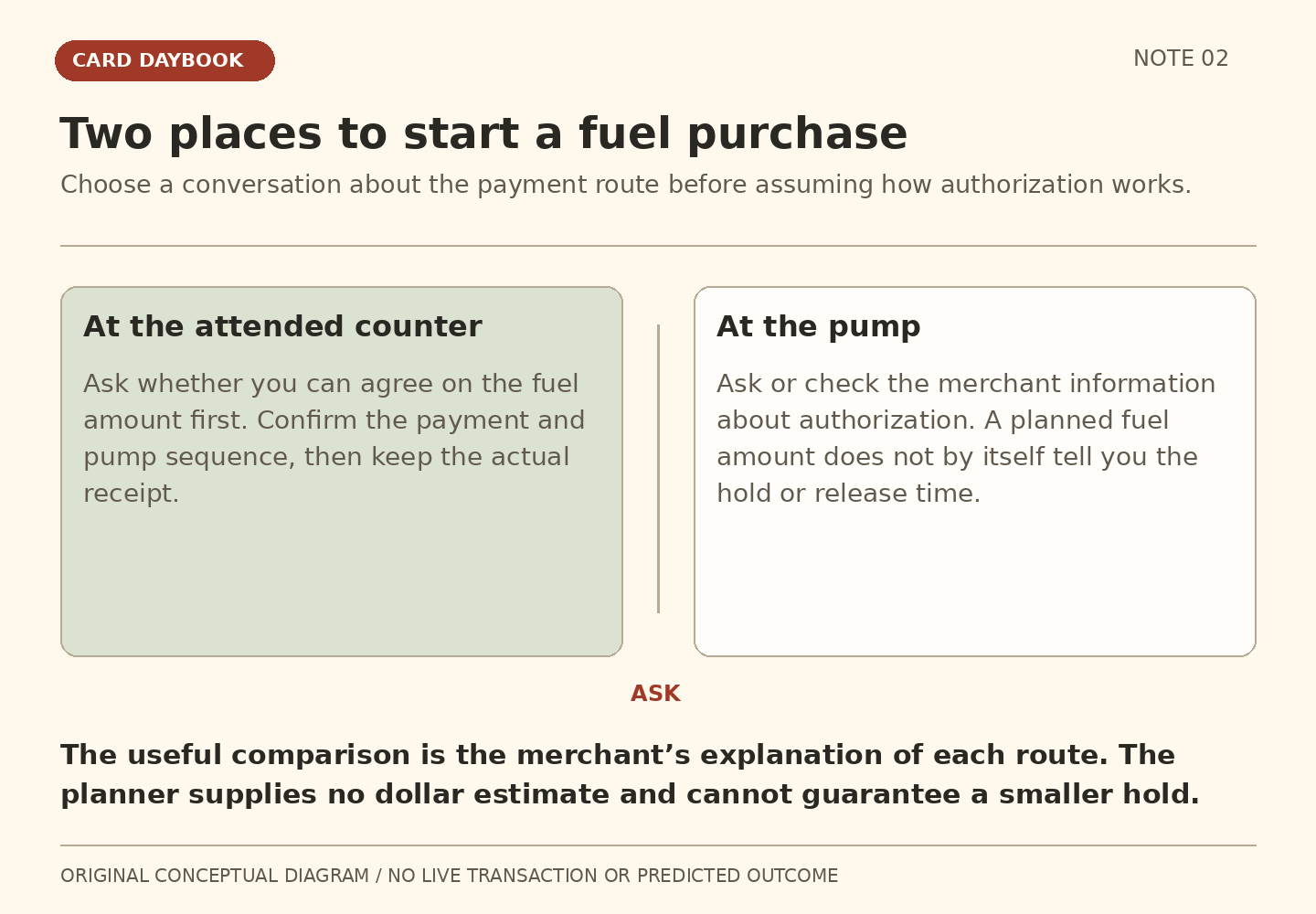
Wisely’s fuel-purchase guidance recommends prepaying an exact amount with the cashier. It warns that paying at the pump can involve a larger temporary hold. Published examples are not a quote for your station or card program.
A purchase limit begins as an instruction
In this fictional example, Owen wants enough fuel for his errands, rather than a full tank. He goes inside before using the pump. He identifies the pump and asks to prepay the amount he has chosen. He also asks what happens if the tank accepts less fuel than he prepays.
That last question prevents an easy misunderstanding. Choosing a purchase amount and confirming the treatment of an unused amount are separate tasks. The cashier may be able to explain the station’s process before the card is presented. Owen does not treat a general recommendation to pay inside as a guarantee that no temporary account entry can occur.
Confirm the pump identifier aloud and on any receipt. A correct payment method still needs the correct destination. If someone else is pumping while you are paying, agree which pump is yours before either person starts. Keep the transaction under your own control; do not hand a PIN to someone as part of coordinating the stop.
Read the screen as a purchase decision
Review what the terminal is asking you to approve. A prompt to buy a wash, enroll in an offer or choose a receipt is separate from the fuel purchase. Take a moment to understand unfamiliar prompts instead of pressing through them to reach the pump. If the terminal is unclear, ask the cashier to explain the purchase being submitted.
At an unattended station, the option to pay a cashier may not exist. The relevant question becomes whether you understand and can accommodate the pump’s authorization process. If you cannot establish that, choosing another station before starting is a valid option. Convenience does not require accepting an unknown process.
If the pump declines, stop the sequence
A decline does not tell you its cause. Avoid moving through repeated attempts at neighboring pumps while assuming each earlier attempt has disappeared. Ask the attendant whether the sale was completed, canceled or left incomplete in the station’s system. Record what they can actually verify.
When a different payment route is proposed, confirm what happened to the original attempt first. If the attendant cannot tell, keep the question open and use the official card-support route for an account-specific explanation. Do not ask store staff to inspect your whole balance history or photograph your card.
The aim is to leave with a simple sequence: where you attempted payment, whether fuel was dispensed, and what the merchant says it completed. That sequence is more useful than a conclusion such as “the pump took my money,” which combines several facts that still need checking.
Match the receipt to the fuel you received
After pumping, Owen looks at the dispenser total and keeps the purchase receipt. In the example, the tank fills before using the entire prepayment. He returns to the counter and asks for a record of how the unused portion was handled. He does not calculate an assumed refund date from a generic internet answer.
- Keep the station location and purchase date so the correct store can find the sale
- Retain the pump identifier when it appears on the receipt
- Separate the requested prepayment from the amount of fuel actually dispensed
- Save any correction or cancellation receipt with the original purchase
If the paper receipt is missing or unclear, ask for an itemized reprint while you are still at the station. A picture of the dispenser can help your own recollection, but it should not be treated as a replacement for the merchant’s payment record.
Handle a changed fuel plan before starting another sale
If you decide you need more fuel after a limited prepayment, ask the cashier how to complete an additional purchase and verify the first purchase’s status. Do not treat an additional amount as an informal extension if the station records it as a separate sale. Retain the receipts together so the extra fuel is understandable later.
The reverse situation deserves the same care. If the pump will not dispense after you paid inside, tell the attendant what you observed and ask what the store will do with that payment. Moving to a different pump may solve the equipment problem, but the payment assignment still needs the attendant’s confirmation.
For Owen, a helpful note separates equipment behavior from payment behavior: the pump did not dispense; the cashier reassigned or canceled the purchase; this is the receipt received. He does not need to decide whether the device, network or card caused the problem before asking the store to identify its own next action.
When the cashier cannot resolve the question immediately, ask how to contact the correct location afterward and retain the reference already created. That is more useful than making another purchase solely to see whether the card works somewhere else.
The useful habit is choosing early
This method is about making one fuel purchase understandable. It does not set a universal hold amount, timing rule or card limit. Your applicable agreement and the station’s verified process are the sources for those questions. Keeping a limited purchase instruction and a final receipt together gives any later conversation a concrete starting point.
Sources and limits
Public sources support the specific statements identified in this note. Questions, fictional situations and conceptual diagrams are original editorial work. Check your own card agreement and the merchant’s current terms; this publication does not verify a real account or promise an outcome.
- What is a pre-authorization hold? · checked October 13, 2026