In this article
A room confirmation can be reassuring without answering the question that matters at the front desk: what must you present, and what amount must be available, to receive the key? A prepaid room price is a record of one purchase. It does not, by itself, explain the property’s check-in requirements. Ask about those requirements while a change is still possible.
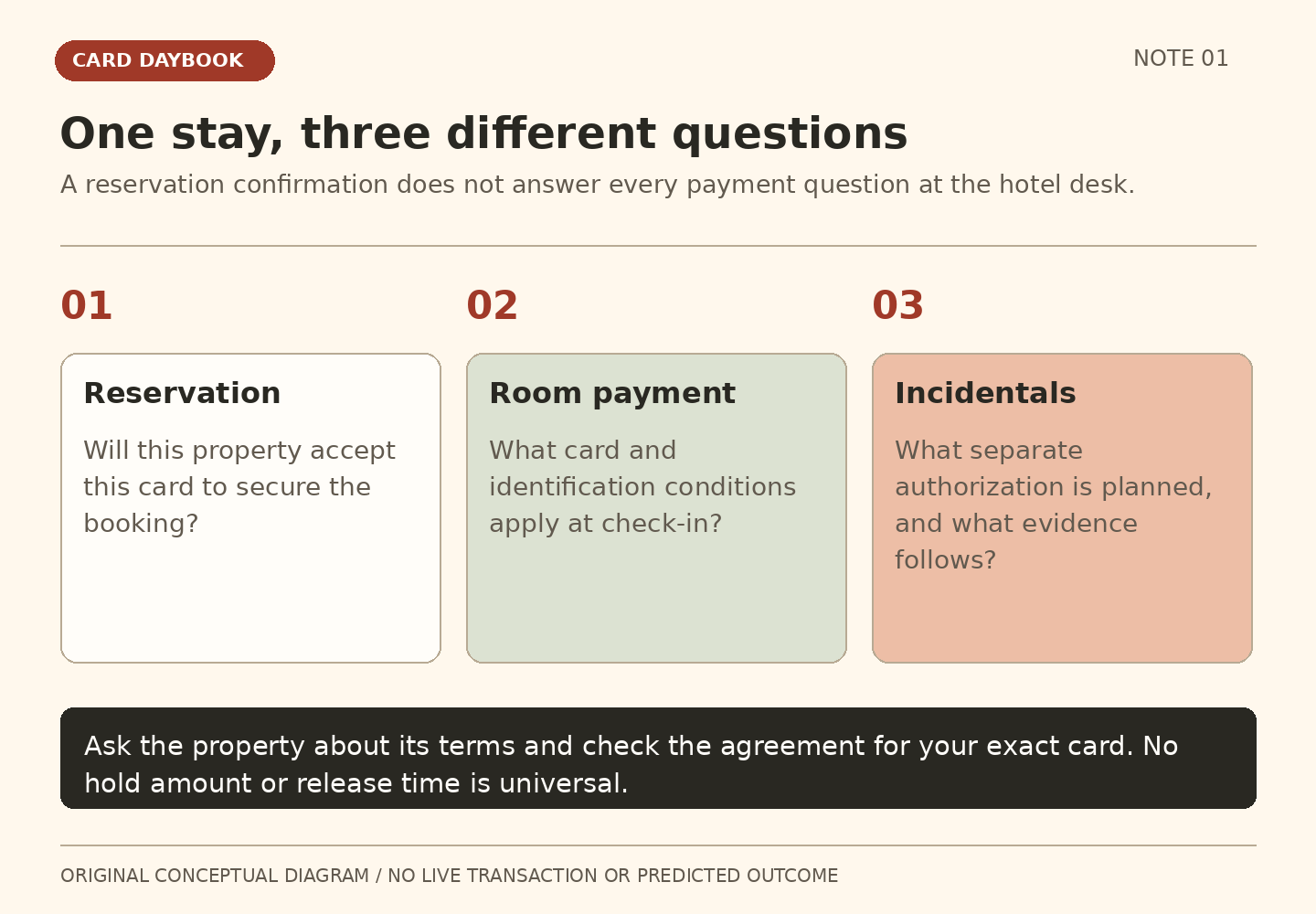
Wisely’s pre-authorization guidance identifies hotels as merchants that may hold funds beyond the final purchase amount. It explicitly treats hold timing as variable. This article makes no promise about an amount or release date.
Start with the property, the stay and the card type
Imagine Lena, a fictional traveler visiting a friend for a weekend. Her booking email says the room is paid. She initially reads that as “nothing more needed.” Before departure, she contacts the property through the number on its verified website and asks whether an incidental deposit is required from a guest using a prepaid debit card.
That description matters more than saying only “Visa” or “Mastercard.” Give the card’s product type and network, without sharing its number in a general inquiry. Ask the person answering to check the policy for the actual property and the way this reservation was purchased. A general reservation line may not resolve a property-specific requirement.
Keep the booking company and the hotel separate in your notes. One may have collected the room price while the other handles check-in. If either sends you to the other, repeat the precise unresolved question rather than restarting with the whole travel story.
Ask questions that produce a usable answer
- Acceptance
- Will this property accept this prepaid card type at check-in for this reservation, including any required deposit?
- Calculation
- What amount will the property request, what does it cover, and could the request change during the stay?
- Payment stage
- Which amounts have already been paid, and which will be authorized or collected by the property?
- Evidence
- Where is that policy written, and what receipt or acknowledgment will the desk provide?
- Departure
- What will the hotel do at checkout, and whom should you contact if the final bill and the deposit record do not match?
These are questions, not a statement that every hotel uses the same process. If the answer is “it depends,” ask what it depends on. The stay length, booking terms or payment method may be the missing input. Do not supply a card number merely to learn a publicly described policy.
Give an uncertain answer the right weight
Lena receives a broad answer from the booking service and a more specific answer from the property. She saves the property’s written explanation alongside the reservation. The useful result is not a homemade guarantee; it is knowing which requirement remains unresolved before she commits to transportation and arrival plans.
If the hotel cannot confirm acceptance, treat that as an open booking issue. Ask about an acceptable alternative and any cancellation or change conditions before making another commitment. Do not assume a second card, cash or another person’s card will be accepted. Each proposed alternative needs the property’s answer.
Also consider what you will need to purchase during the stay. A plan that works only if the deposit becomes usable immediately after checkout is vulnerable to timing you do not control. This is a practical timing observation, not a recommendation to borrow or purchase another financial product.
Use check-in to confirm, not to discover
At the desk, compare the requested amount with the explanation you saved. If it differs, ask for the components before authorizing it. Check whether the screen describes a deposit, a room charge or an additional service. Declining an optional purchase and questioning a required deposit are different conversations.
At checkout, request the final itemized folio and identify any outstanding question while staff can still see the reservation. Save the property’s reference number and the date of its response. A statement that the hotel completed its step is useful evidence, but it is not a promise that the card account will display an immediate change.
Sort the answer into a booking decision
Once you have the property’s response, put it into a decision you can actually use. If it confirms acceptance and explains the requested amount, compare those conditions with your own plan. If it confirms acceptance but leaves the deposit unclear, the payment question is still open. If it does not accept the proposed method, having enough money on that method does not resolve eligibility.
Record the answer’s limits. “Accepted for the room charge” is narrower than “accepted for the required check-in deposit.” “Ask at arrival” leaves the decision until after you have traveled. Neither response should be expanded into a stronger assurance in your notes.
For Lena, the appropriate question is whether she can proceed with this stay under the conditions the property actually describes. She does not need to prove that the hotel’s policy is typical. She needs a plan that works for the specific reservation she intends to keep.
If the booking was made through someone else
Keep each party’s responsibility visible. Ask the booking service about the payment it collected, its change rules and any statement it made about the reservation. Ask the property about what it will require at the desk. If the answers conflict, describe the conflict directly to both parties instead of silently choosing the more convenient answer.
A useful question is: “The booking confirmation describes the room as prepaid, but the property says it requires a separate check-in deposit. Where can I see the terms that apply to that deposit?” This requests a missing explanation without asserting that the charge is wrong or that the booking company can change the hotel’s process.
If another person is paying
Do not assume that a friend’s offer to pay solves the check-in question. Ask the property whether the payer must be present, whether the guest and cardholder names must match, and what process applies if someone else covers the stay. These are verification questions; this guide does not establish the property’s answers.
Keep the arrangement limited to what each person agreed to cover. Paying for the room does not necessarily mean agreeing to every incidental purchase. Discuss optional charges among yourselves before presenting payment, and avoid sending card photographs through a group chat as an improvised authorization method.
Recheck when the stay itself changes
A clear original answer may no longer answer a changed reservation. If Lena adds a night, changes the room arrangement or moves the arrival date, she asks whether the property’s requested payment or deposit changes. She keeps the revised explanation with the revised booking so the old answer does not remain the most visible one.
Use the same discipline when an optional service is added at the desk. Ask whether the new total includes that service and whether any separate authorization is proposed. An upgrade offered during a busy arrival is still a new purchase decision. Take time to distinguish what is required for the booked stay from what is being offered as an addition.
If you decline an addition, confirm that the amount shown has been updated before approving payment. If a correction is needed after an attempt, ask what the property completed and what remains open. Repeatedly presenting different cards without understanding the earlier attempts makes the final folio harder to interpret.
Plan a useful conversation after checkout
When a question remains, start with the final folio and the deposit record rather than the original advertised room price. Identify the particular amount or description you need explained. Ask the property to state what it processed and when, and request any reference it can provide for that action.
Suppose Lena’s folio is correct but the property says a deposit-related step has already been completed. Her next task is to retain that statement and seek an account-specific explanation through official card support if needed. She does not need the hotel employee to diagnose the card account, and she does not need card support to reconstruct the room’s itemized charges without the folio.
If the property cannot find the reservation, provide the booking reference through its verified contact route. Share only the relevant page or transaction details it needs. A full screenshot of unrelated card activity exposes more than the inquiry requires. Keep any private copies separate from reviews or public travel discussions.
Set the next check from the actual answer you receive. If someone promises a follow-up, record who is responsible and what information they will provide. If no timeframe is supplied, ask what next step applies rather than inventing a release deadline. The goal is an accountable inquiry with a clear missing fact, not an endless sequence of checking the same screen.
What this preparation can establish
The finished note should let you say: this is the property’s stated policy, this is the reservation it applies to, and this is the unresolved detail, if any. It cannot establish a reader’s actual available funds or override their card agreement. Card Daybook provides independent purchase education and does not access reservations or card accounts.
Sources and limits
Public sources support the specific statements identified in this note. Questions, fictional situations and conceptual diagrams are original editorial work. Check your own card agreement and the merchant’s current terms; this publication does not verify a real account or promise an outcome.
- What is a pre-authorization hold? · checked October 13, 2026