In this article
A store return has a physical side and a recordkeeping side. You hand back an item, and the merchant records what it accepted and what happens next. Paying attention to both sides makes it easier to resolve a question later without reconstructing the purchase from memory.
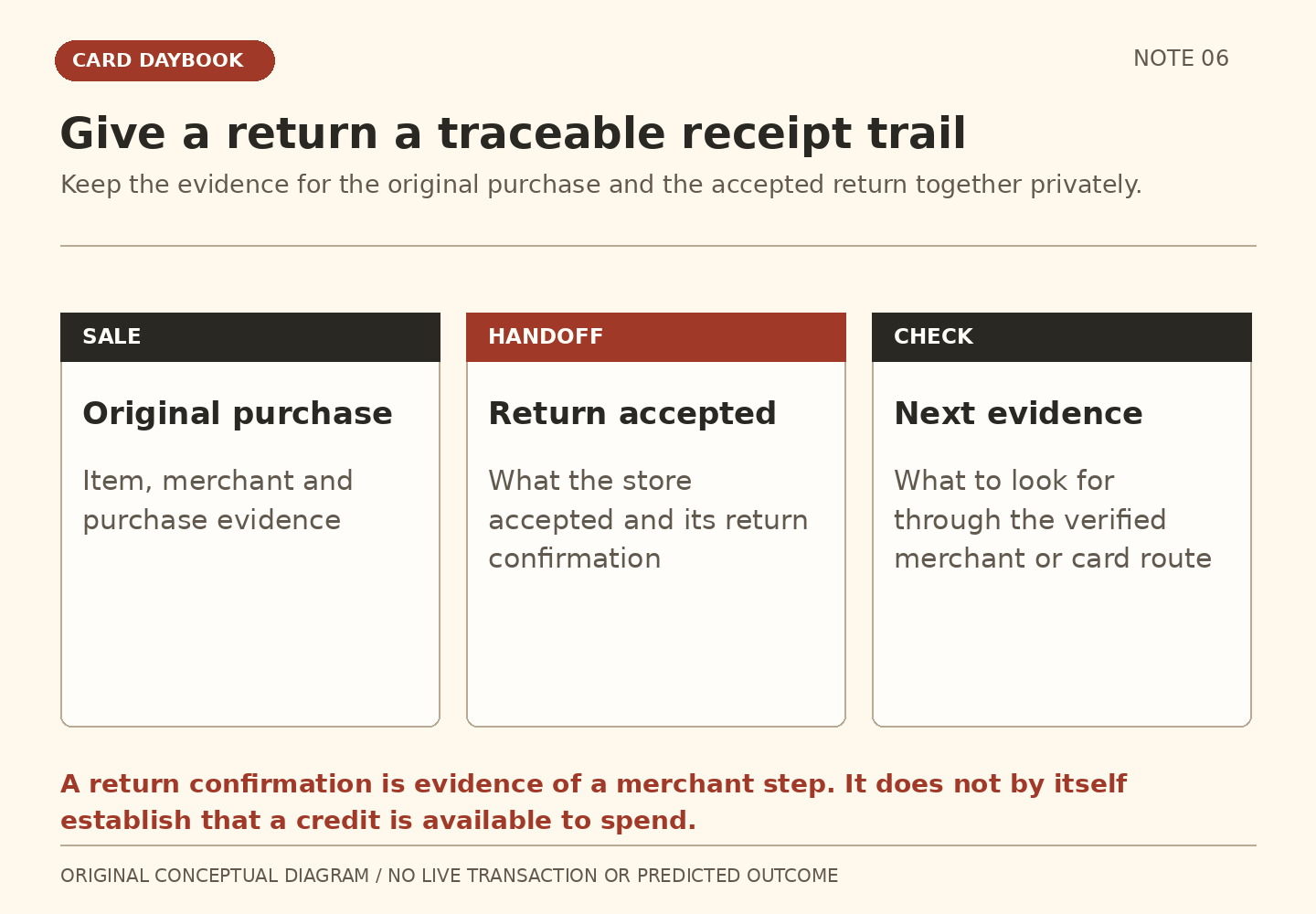
Bring the record for the item being returned
June is a fictional shopper returning a lamp from a larger household purchase. Before visiting the store, she checks its return instructions for that item and brings the original receipt. She identifies the lamp’s line on the receipt so the return does not become a search through unrelated purchases at the counter.
Read any conditions the merchant says apply, including where the item must go and what packaging or documentation is needed. If the instructions are unclear, ask before traveling or shipping. This article does not assume a universal right to return an item or a uniform return window.
If the original order came from an online marketplace, verify whether the physical store can handle that seller’s return. A familiar brand on the storefront is not enough evidence that it accepts every order placed through an associated website.
Make the handoff observable
At the counter, compare the item and quantity being entered with what you are handing over. Explain whether you are returning the whole purchase or only part of it. If you want an exchange, ask how the store records the returned item and replacement; do not assume the receipt for one explains the other.
For June, the useful question is concrete: does the return receipt identify the lamp, and does the amount match the merchant’s explanation? A broad assurance that “it is taken care of” is less useful than a document she can check while still at the store.
If you leave an item for inspection rather than an immediately accepted return, request a record of that status. “Received for review” and “return accepted” describe different outcomes. Preserve the merchant’s actual wording instead of marking the refund complete in your own notes.
Read the destination as well as the amount
Ask how the merchant will handle the return under the applicable policy. Is it a credit to the original payment method, an exchange or store credit you have agreed to accept? If the purchase used more than one method, ask how the return amount will be allocated.
Use masked card details or the original receipt to identify a payment method where the merchant’s process allows. Do not send complete card credentials through email to clarify a return. If a replacement card makes the destination unclear, ask the merchant and official card support for their process rather than selecting a new destination on your own.
Wisely’s pending-refund FAQ says a pending credit is not included in available funds until it fully posts and clears. A store’s return receipt therefore should not be treated as proof that the money is already ready for another purchase.
Keep a short chain of evidence
- Retain the original purchase record that identifies the item and payment.
- Keep the merchant’s return authorization or instructions when one was issued.
- Save the counter receipt or shipping handoff record showing what was returned.
- Add the merchant’s acceptance or processing confirmation, including any reference.
- Record the later outcome or the precise question still unresolved.
For a shipped return, a carrier’s delivery record establishes delivery, not necessarily the merchant’s inspection result. Keep those stages separate. If the seller requests photographs of a product problem, avoid including unrelated personal information in the background.
Give a partial return its own explanation
If the item was part of a promotion or bundle, ask the merchant to explain the return amount rather than calculating it from a remembered shelf price. The purpose is to understand the applicable purchase and return record, not to assume that every discount is allocated in the same way.
June compares the merchant’s explanation with the original receipt. If she keeps accessories that were sold with the lamp, she asks whether the store considers the return complete before handing over the item. This avoids discovering afterward that the record describes a different set of goods than the one she returned.
For a refused return, keep a brief note of the reason and the policy the store cited. If you want the decision reviewed, ask for the appropriate merchant route and present the specific mismatch you believe exists. A refusal is not proof of a card-processing failure, and a payment provider cannot supply missing facts about what the store accepted at the counter.
Ask the next owner the question they can answer
If June’s return record shows the wrong item, the store is the place to clarify that record. If the store says it processed the return but the account outcome remains unclear, she can take the merchant’s reference to official card support. Neither conversation needs a public post containing her transaction history.
Ask about applicable deadlines promptly rather than letting a general estimate become an indefinite wait. This guide supplies no universal processing time and does not decide whether a particular refund is owed. A merchant’s explanation should be documented without turning it into a guarantee.
June’s finished receipt trail connects the lamp she returned to the merchant’s actual decision and the eventual payment outcome. The method stays small because each record has a purpose. Card Daybook cannot approve a return, access an account or recover money for a reader.
Sources and limits
Public sources support the specific statements identified in this note. Questions, fictional situations and conceptual diagrams are original editorial work. Check your own card agreement and the merchant’s current terms; this publication does not verify a real account or promise an outcome.
- Do pending credits from returns/refunds count in my available balance? · checked October 13, 2026